

Modern histories of Australia hold a distinctly protestant view of the continent’s colonization: that our land was first discovered by Dutch explorers in the early 17th century and then eventually settled by anti-Catholic British in 1770. The vast new terrain, rich in arable land and natural resources, was first earmarked as a penal settlement to take the pressure off Britain’s overcrowded jails. This led to the realization that the thousands of convicts would make a convenient workforce and so a prosperous colony quickly sprang up, bringing with it the Anglican culture of the British. Little did these first settlers realize, however, that the great Terra Australis had been claimed in the name of the Catholic Church almost two hundred years earlier.
Whether by design or simply due to unfavorable circumstances, the role played by Catholics in the founding of Australia has largely become lost in the mists of time. Cardinal Patrick Moran, Archbishop of Sydney from 1884-1911, felt so strongly about the need for an accurate history that he undertook extensive research on the topic himself. The Cardinal had always had an interest in history and wrote many books on the subject of his homeland, Ireland. Although somewhat naive (it is said he did not believe Modernism posed a threat to Australia) he seems to have been a conscientious pastor and a defender of orthodoxy.
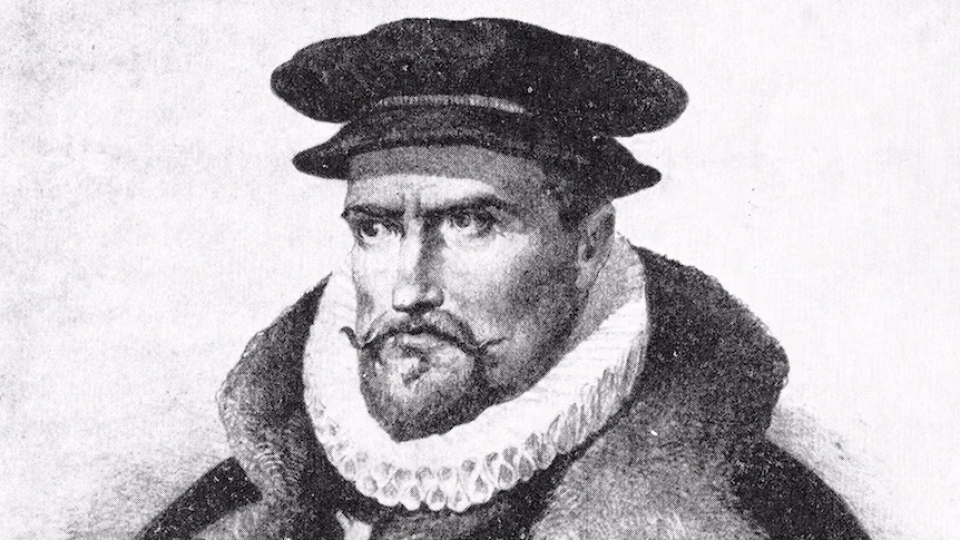
Cardinal Moran thought that the usual account of Australia’s discovery by Dutch Protestants was anti-Catholic bigotry and sought to give credit to the Spanish Catholic explorer, Pedro Fernandez de Quiros. De Quiros and his more famous companion, de Torres, were believed at the time to have discovered not Australia, but instead Espiritu Santo, the largest island of Vanuatu. The error came about largely because the account written by De Quiros of his 17th century voyage to the Southern Hemisphere, was not translated from Spanish for several hundred years.
When talks and documents relating to de Quiros’ voyage were translated around the turn of the century, interest grew in the idea that he had, in fact, landed on Australian soil. Cardinal Moran drew on these sources and in 1906, his book, The Discovery of Australia by de Quiros, was published by the Catholic Truth Society.
This is especially significant for Catholics, since de Quiros sailed as a faithful Catholic and claimed the new-found land for God and the Church. Prior to his voyage, De Quiros had made a pilgrimage to Rome for the Jubilee year, and sought an audience with Pope Clement VIII.
Cardinal Moran put forward an excellent case for de Quiros and Torres landing on the east coast of Australia in May of 1606. This was only months after the Dutch protestant Willem Jansz discovered and charted Cape York Peninsula to the north. Jansz mistakenly thought that the peninsula was attached to New Guinea and Dutch charts continued to repeat that mistake for many years afterwards.
Cardinal Moran compared geographical features of Espiritu Santo, the island supposedly discovered by de Quiros, with an area of the north Queensland coast, and found that the latter fitted the explorer’s description more accurately. Moran found that the weather, the natural resources and even the beach pebbles in Queensland closely matched descriptions found in de Quiros’ records. For Cardinal Moran and many of his fellow members of the Melbourne Geographical Society, there was no doubt that de Quiros had landed in Australia, and not Espiritu Santo.
This is especially significant for Catholics, since de Quiros sailed as a faithful Catholic and claimed the new-found land for God and the Church. Prior to his voyage, De Quiros had made a pilgrimage to Rome for the Jubilee year, and sought an audience with Pope Clement VIII. The Pope gave de Quiros his blessing, along with a relic of the True Cross, and after many difficulties, de Quiros eventually set sail with support from the King of Spain, Philip III.
On May 1, 1606, De Quiros and his crew landed on the coast of what is now Queensland, Australia. His records reveal this official declaration made two weeks later:
‘Let the heavens, the earth, the waters with all their creatures and all those here present witness that I, Captain Pedro Fernandez de Quiros, in these hitherto unknown parts, in the name of Jesus Christ, Son of the Eternal Father and of the Virgin Mary, God and true man, hoist this emblem of the Holy Cross on which His person was crucified and whereon He gave His life for the ransom and remedy of all the human race, being present as witnesses all the land and sea-going officers; on this Day of Pentecost, 14 May 1606.’
De Quiros named the new land “The Great Southern Land of the Holy Ghost” and placed it under the patronage of St. Francis and St. John of God. He and his crew set about exploring the area, even building a small chapel.
De Quiros named the new land “The Great Southern Land of the Holy Ghost” and placed it under the patronage of St. Francis and St. John of God. He and his crew set about exploring the area, even building a small chapel. As an indication of the Catholic devotion of the exploration party, the whole crew celebrated the feast of Corpus Christ on May 21, 1606 with de Quiros dedicating an entire chapter of his book to describing it.
De Quiros records that prior to the feast day, carpenters, protected by a detachment of 100 soldiers, were sent onshore to prepare a wooden road for the procession. The vigil of Corpus Christi was kept on board the ships, then the crews went ashore before daybreak for the celebration accompanied by six monks. The chapel had been decorated with boughs of greenery; there was an altar with canopy, silver sacred vessels and incense. Arches had been set up along the procession road, with little altars dedicated to Sts Peter and St Paul.
“Then followed the royal standard, accompanied by the Master of the Camp, the Sergeant-Major, and the Captains. Then six Magistrates, each with a lighted torch in his hand. Then came the Father Commissary, whose pall of yellow silk, six yards long, was borne by three royal officers and three Magistrates. He carried in his hand a coffer of crimson velvet, with gilded nails, which contained the most Blessed Sacrament.
“Another lay brother incensed it. All the four priests marched joyfully, singing the hymn, “Pange lingua.” The Captain carried the royal standard as far as the door, where he delivered it to the Ensign, whose place was behind the pall, with the two Justices of the Peace and the Chief Constable. When the Lord now came forth from the door, all the bells rang, and the people, who were looking on attentively, fell on their knees ; the Ensigns lowered the banners three times, the drummers beat the drums for battle ; the soldiers, who had the cords ready, fired off the muskets and arquebuses ; the constables fired off the guns which were on shore for defending the port ; and in the ships the artillerymen fired off the bombards and pieces, and those placed in the launch and boats for the occasion.
“Once more, and once again, they were discharged. When the smoke cleared away, there were seen amongst the green branches so many plumes of feathers and sashes, so many pikes, halberds, javelins, bright sword-blades, spears, lances, and on the breasts so many crosses, and so much gold, and so many colors and silken dresses, that many eyes could not contain what sprung from the heart, and they shed tears of joy.” [from The voyages of Pedro Fernandez de Quiros, 1595 to 1606. Translated and edited by Sir Clements Markham.]
Our highly secularized nation would benefit from learning the part played by faithful Catholic explorers in its discovery. Let us pray that one day our leaders, like Quiros and his crew, will acknowledge the True Faith and build Australia’s future on the Holy Cross of Christ.
