
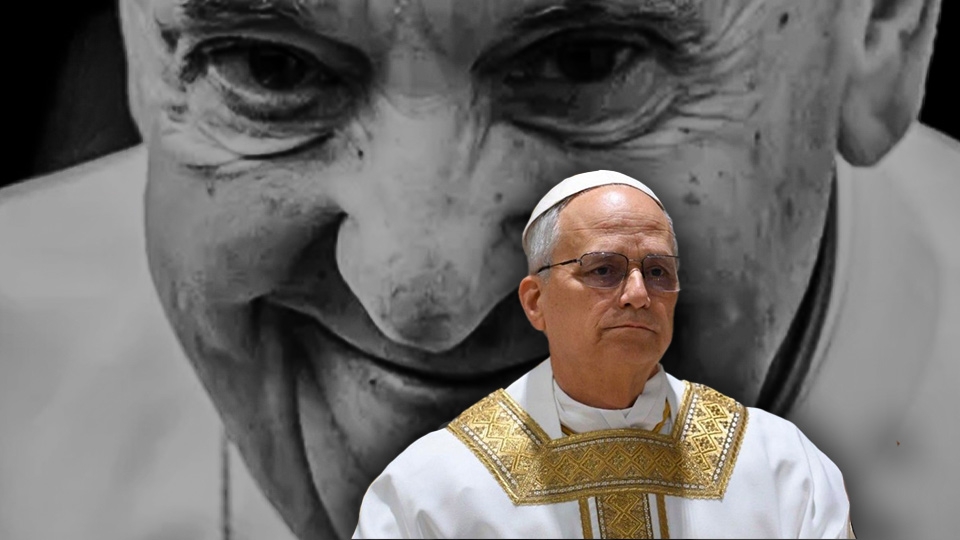

On October 9, 2025, Pope Leo XIV released the Apostolic Exhortation Dilexi Te (“I have loved you”). The magisterial document centers on love and care for the poor. The text — no need to spell it out, it’s fairly obvious — was drafted during the final days of Francis’s pontificate and shelved in some junior official’s drawer at the Secretariat of State.
Ideally, it was meant to be a sequel — or rather a spin-off — to Dilexit Nos, Pope Francis’s encyclical on the Sacred Heart of Jesus (which, in truth, offered a sentimental and problematic reinterpretation of a theme especially dear to more conservative Catholics: I analyzed it at length here).
Pope Leo owes much to Francis on several fronts — not least the trust placed in him as Prefect of the Dicastery for Bishops and as cardinal (no small gestures, given Bergoglio’s temperament). But Leo is also indebted to Francis for the ecclesial vision he championed: synodal, decentralized, and collegial. This, despite what conservatives may claim when they cast Prevost as a kind of restorer of the Wojtyła–Ratzingerian dominion.
It is a profoundly flawed framework which, as Leo himself acknowledges in the document, stems from the theology of the people — that theological current developed in Argentina after the Second Vatican Council and the 1968 Medellín Conference, as an autonomous offshoot of (the condemned) liberation theology. Needless to say, Bergoglio was steeped in theology of the pueblo to the core.
Leo, to be sure, does not share Francis’s impulsive, irascible, and at times even contradictory style — a Pope who preached democracy in words while practicing the most reactionary form of authoritarianism in deeds. Nor does Leo embrace the more extreme (and logically consistent) consequences of Francis’s vision — namely, the overturning of ecclesiastical hierarchy, or Revolution (to use the proper philosophical and theological terms).
Instead, he prefers to preserve a certain structure of roles and ranks, because — as he reiterated in his recent book-length interview — “democracy is not always a good thing” (on which, I commented here).
There is much to be said about this first magisterial document of Pope Leo XIV — starting with the social and political analysis he offers on the problem of poverty, the causes he identifies, and the solutions he proposes. It is a profoundly flawed framework which, as Leo himself acknowledges in the document, stems from the theology of the people — that theological current developed in Argentina after the Second Vatican Council and the 1968 Medellín Conference, as an autonomous offshoot of (the condemned) liberation theology. Needless to say, Bergoglio was steeped in theology of the pueblo to the core.
We will not address the socio-political dimension of Dilexi Te here, but rather its theological-moral aspect.
The theme of the poor is, of course, both important and central to the life of the Catholic Church. The section of the document that traces this history is, among other things, quite compelling.
However, Dilexi Te fails to answer the deeper and more essential question — namely, why the Church has concerned itself with the poor, and above all, what the Church has always seen in the phenomenon of poverty.
Sure, Pope Leo reminds us that in the poor the Church finds and recognizes the face of Christ. Yet the reason why this is so is not made equally clear. It is said that the Church sees in the poor the reality of human suffering and is therefore called to bring relief — but this answer does not help us understand how the Church differs from the world.
After all, worldly powers also preach sensitivity toward the marginalized and excluded. The very reference Leo makes at the beginning of his document to the UN’s Millennium Goal of “eradicating poverty” confirms this. So the question is: does the Church position herself as ancillary to this discourse, or as a point of difference? That is the question.
Does the Church love poverty, or does it love the poor? Are the two things interchangeable? And further: if the Church loves poverty, is it because poverty is intrinsically good? Is poverty a univocal concept, or are there multiple meanings of poverty? As is evident, the issue is highly delicate and multifaceted, and Pope Leo (pardon, Pope Francis) strives to address many of these questions — none of which are trivial or easily resolved.
“We should perhaps speak more correctly of the many faces of the poor and of poverty – Pope Leo writes – since it is a multifaceted phenomenon. In fact, there are many forms of poverty: the poverty of those who lack material means of subsistence, the poverty of those who are socially marginalized and lack the means to give voice to their dignity and abilities, moral and spiritual poverty, cultural poverty, the poverty of those who find themselves in a condition of personal or social weakness or fragility, the poverty of those who have no rights, no space, no freedom.”
Aside from this brief mention, however, there are no other points in the Exhortation that delve into the concept of spiritual poverty referenced here — a form of poverty which, upon closer inspection, is in fact the most serious. Not only does it harm man in his innermost dimension and remain independent of his economic condition (one can be a billionaire and spiritually destitute), but spiritual poverty is also the true root cause of material poverty.
The issue is that by juxtaposing spiritual poverty with moral poverty — as Pope Leo does in his list of poverty forms — there is a risk of conflating and confusing the two planes, leading one to believe that spiritual poverty consists merely in an inability to discern or in a habitual omission of good works.
Spiritual poverty, by contrast, consists in sin and vice. (A few noteworthy details: the word “sin” appears only six times, mostly in biblical references or in connection with Bergoglio’s notion of “social sin”; the word “vice” does not appear at all.)
Spiritual poverty is — put simply — the absence of God’s grace in the life of the human person. This is the greatest misfortune and the deepest misery, the source of all evil that exists on both the individual and societal level.
Another form of poverty that goes unmentioned is intellectual poverty — that is, ignorance — which, properly understood (as we have seen), is closely tied to spiritual poverty. This form of poverty is not merely about literacy or erudition (indeed, the Pope extensively addresses the theme of cultural poverty, which is something else entirely), for Western modernity has witnessed an unprecedented expansion of schooling in human history, which nonetheless has failed to elevate or rationally emancipate the masses. On the contrary, it has been exploited by revolutionary thought to corrupt the intellect.
With all due respect to Kant, who proclaimed and portrayed the Enlightenment as “man’s emergence from his self-imposed immaturity” — a condition he attributed to religion, and to Catholicism in particular.
In essence, Pope Leo states that the poor exist because certain individuals accumulate wealth — more or less excessively. The State, or better yet international bodies, would therefore have the right to monitor these private actors and curb their growth, redistributing resources (money, homes, land) equally among all.
Put this way, it reads like a troubling Marxist manifesto — but that is precisely what one finds in Dilexi Te, once all the typical expressions of Christian language are stripped away. Christian doctrine, by contrast, has always taught that the root of all evil is sin, which kills grace — that is, what we might call “spiritual poverty”.
It is not wealth, but the absence of grace that causes imbalance in the world. And it is not socialism, but the Social Kingship of Christ that offers resolution — without falling into disappointing utopian visions of the world.
Indeed, St. Thomas Aquinas writes that sin is a disorder, and since it goes against divine justice, it follows that it introduces a certain corruption and defect into human nature (cf. Summa Theologiae I-II, q. 85, a. 3). Elsewhere in the Summa (II-II, q. 118, a. 1, ad 3), St. Thomas teaches that wealth — like any means — is neither good in itself nor evil, but is good instrumentaliter, “as an instrument”.
To claim that one person’s wealth is the primary cause of another’s poverty is a highly dangerous assertion — one that risks being co-opted in a socialist sense, as is already happening within the Catholic Church.
It is neither wealth nor poverty that saves the world, but the grace of God. And without grace, not only wealth but even poverty risks becoming idolatry. This is precisely what we are witnessing today — even within the Catholic Church.
If sin is the root of evil in society, it might even be accurate to say that Jesus was a “poor Messiah for the poor”, as Pope Leo puts it. But the evangelical poverty lived by Christ should not be understood as economic destitution — even though, as several Gospel passages suggest, the Holy Family of Nazareth did at times endure severe material hardship.
Rather, it should be understood as detachment from the disordered possession of goods. Christ did not beatify material poverty, but “poverty of spirit” — that is, interior freedom from greed and material attachments, which is necessary for the believer to be filled with the gifts of the Holy Spirit.
Christ Himself had wealthy friends: consider Zacchaeus or Lazarus, who — as Tradition reports and the Gospels clearly suggest — was a man of considerable wealth and even political influence. Joseph of Arimathea and Nicodemus were both members of the Sanhedrin, affluent and respected, yet both were disciples of Christ. Joseph of Arimathea offered his new tomb for the crucified body of Jesus — a symbol of how the righteous rich can place their possessions at the service of God and neighbor. It is not necessary for the State to intervene forcibly to “educate” the wealthy.
It is neither wealth nor poverty that saves the world, but the grace of God. And without grace, not only wealth but even poverty risks becoming idolatry. This is precisely what we are witnessing today — even within the Catholic Church.