
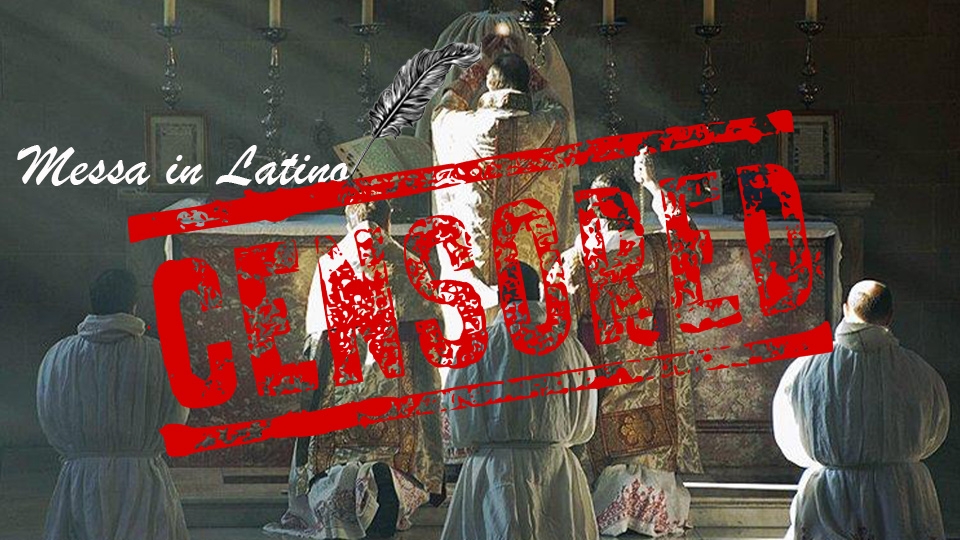

On July 11, 2025, the blog Messa in Latino was removed without any prior notice from the Blogspot platform, owned by Google. This is truly alarming because the site was the primary source of unofficial Catholic Traditionalist news, often straight from the Vatican and the Holy See.
Last Friday morning, July 11, 2025, the blog Messa in Latino was removed without any prior notice from the Blogspot platform, owned by Google. Since then, visitors are met with the blunt message: “Sorry, the blog has been removed and the address is not available for new blogs.” This development—widely covered by Italian press (see here, here, here, here, here, here) and also echoed abroad (see here)—has taken on truly alarming proportions when one considers that the site, while not a formal news outlet, was the primary source of unofficial Catholic Traditionalist news, often straight from the Vatican and the Holy See.
Just to illustrate: Messa in Latino recorded over one million global page views in the month of June 2025 alone, with 22,000 posts published or archived, and around 250 more already scheduled for release. Founded in 2007 following the publication of Benedict XVI’s Motu Proprio Summorum Pontificum, the blog became one of the most prominent critical voices against Pope Francis in Italy starting in 2013.
In a private email sent to the blog’s main administrator, Google immediately issued a notice explaining that the site had been removed due to alleged “hate speech.” In reality, messainlatino.it has done nothing over the years but defend and spread Catholic doctrine, promote love for the Vetus Ordo liturgy, and denounce errors and abuses both inside and outside the Catholic Church.
It has often published firsthand sources well ahead of others, concerning documents, reforms, scandals, and internal proceedings within the Leonine Walls. A blunt and uncompromising blog, no doubt—but always respectful of truth and of the Church’s hierarchy.
The blog was run by four Italian lay Catholics, but the most recognizable figure is undoubtedly that of entrepreneur Luigi Casalini. A longtime friend of this writer, Luigi is certainly not someone who spreads hatred or discord—rather, he is a candid individual who contributes, with the resources at his disposal, to the protection and promotion of Catholic worship. During the three years I collaborated with Fede & Cultura—Italy’s most prominent Catholic publishing house in the traditionalist sphere—I frequently had the chance to organize livestreams featuring Casalini. And I consistently noticed something rather curious: YouTube, also owned by Google, regularly penalized and limited the visibility and distribution of these videos. Casalini’s remarks were typically aimed at (very politely) criticizing certain decisions made by Pope Francis. Has Google suddenly become an ardent defender of the papacy? We have serious doubts about that.
A troublesome investigative book?
It remains unclear which specific post or statement triggered Google’s censorship. In recent months, Google had already taken down several particularly sensitive articles without warning—only to restore them later, after the blog’s administrators requested clarification. These included: an interview with Bishop Strickland opposing the admission of women to the diaconate; a scholarly piece by Professor Corrado Gnerre exploring the fraught historical relationship between the Catholic Church and Masonic obediences; a reference to official Catholic doctrine on same-sex relationships; and finally, a post dating back over ten years featuring a video of Kiko Arguello, founder of the Neocatechumenal Way, in which he expressed hope that Pope Benedict XVI would pass away.
What likely triggered the guillotine this time was an interview conducted by Luigi Casalini with Fr. Nicola Bux. Fr. Bux co-authored the book La Liturgia non è uno spettacolo, an investigative work released in the midst of the scandal surrounding Pope Francis’s Motu Proprio Traditionis Custodes. Curiously, the book was also removed from Amazon around the same time.
More likely, however, what triggered the guillotine this time was an interview conducted by Luigi Casalini with Fr. Nicola Bux (available in Italian here). Together with well-known Catholic commentator Saverio Gaeta, Fr. Bux co-authored the book La Liturgia non è uno spettacolo (Fede & Cultura, 2025), an investigative work released in the midst of the scandal surrounding Pope Francis’s Motu Proprio Traditionis Custodes. Curiously, the book was also removed from Amazon around the same time.
In the book, Bux and Gaeta revisit the concerns already raised several days earlier by Vatican journalist Diane Montagna, offering a deeper exploration from both historical and theological perspectives. Saverio Gaeta skillfully traces the entire history of the “liturgical war” waged over the past century by ecclesiastical Freemasonry and neomodernist theologians—from the reforms preceding 1962, to Summorum Pontificum, and ultimately Traditionis Custodes. Particular emphasis is placed on the work of the Consilium established by Paul VI to clarify and implement the directives of the conciliar Constitution Sacrosanctum Concilium regarding the liturgy and its reform.
Fr. Bux had already spoken exclusively with us at The Remnant about the importance of recovering, studying, and delving deeper into these works. Readers can find the full interview with Fr. Nicola Bux at this link.
Bux and Gaeta’s book goes on to thoroughly analyze the now-famous questionnaire on the pastoral effectiveness of Summorum Pontificum, circulated in 2020 at the behest of the then Congregation for the Doctrine of the Faith, which had yielded positive results. Those results, however, were allegedly tampered with and manipulated by Francis and his most fervent anti-Tridentine allies (Roche, Viola, Parolin—see here for details), in order to ban the free celebration of the Mass according to the Extraordinary Form of the Roman Rite. Could this be the real reason behind Google’s censorship? Accusing Francis of having “lied” (not my words—I usually prefer a moderate tone—but those of a sizable number of commentators and Vatican observers from around the globe) about the true intentions of the bishops?
Fr. Bux responded to Casalini’s final question: “Whoever devised Traditionis Custodes distorted the synodality expressed by the bishops in their answers to the questionnaire. Regarding these ‘sins against synodality,’ let us gradually return to the status quo from before. The entire Church will benefit from it.”
This was Fr. Bux’s response to Casalini’s final question: “Whoever devised Traditionis Custodes and its related measures did not implement synodality. Not only that: they distorted the synodality expressed by the bishops in their answers to the questionnaire [emphasis ours, Ed.]. Regarding these ‘sins against synodality,’ let a mea culpa be made, and let us gradually return to the status quo ante. The entire Church will benefit from it.”
The implications of such censorship
Let us return for a moment to the accusation leveled by Google against the blog Messainlatino.it. Is Catholic doctrine truly a discourse that incites hatred?
In the meantime, after (unsuccessfully) sending Google a letter co-signed by four lawyers, highlighting the unjustified suppression of freedom of the press and expression—explicitly protected by Article 21 of the Italian Constitution—an emergency legal proceeding has been scheduled for Monday, July 14, 2025. The case seeks a judicial review of the decision to de-index and obscure the blog’s content, in accordance with Article 700 of the Italian Code of Civil Procedure, and requests the immediate suspension of the platform’s action and restoration of the site’s visibility, pending an ordinary ruling.
Italy is, supposedly, the quintessential Catholic country. But if even in Italy it is no longer permitted to publicly profess the Catholic faith in its most pure and integral form, where else will it be? Where can the Traditional Mass still be defended, the Catechism quoted, theological errors denounced, and appeal made to the Church’s enduring Tradition? To what extent is it reasonable to suspect that a systematically anti-Christian mindset is influencing the criteria by which global platforms decide what can or cannot be said? And to what extent can one tolerate that Christ’s doctrine—built upon the inseparable union of truth and charity—is being labeled as “hate speech”?
This censorship is not merely against a blog: it is a symptom of real hatred—the world’s hatred—directed at faith and at the freedom of Catholics. A mute Church is desired: submissive, molded to fit the logic of political and media power.
Are we not, by now, immersed in a new form of totalitarianism? A subtle, digital totalitarianism that—for the moment, at least—does not come dressed in uniforms or wielding batons, but cloaked in algorithms and opaque policies, enforced by the quiet power of automated censorship and “terms of service.” Yet it is precisely this silence that harbors its deepest danger. We no longer erase the person—we erase the word. And with it, memory. And with it, truth.
This censorship is not merely against a blog: it is a symptom of real hatred—the world’s hatred—directed at faith and at the freedom of Catholics. We have long entered a historical moment in which fidelity to Christ and to the eternal Church is not merely poorly tolerated, but actively persecuted. A mute Church is desired: submissive, molded to fit secular mentality, the rhetoric of inclusivity, and the logic of political and media power. But is this not precisely the worldly spirit the Lord sternly warned us against?
Latest on RTV — MASS DECEPTION: Vatican Push to Cancel Latin Mass Based on Fake News