
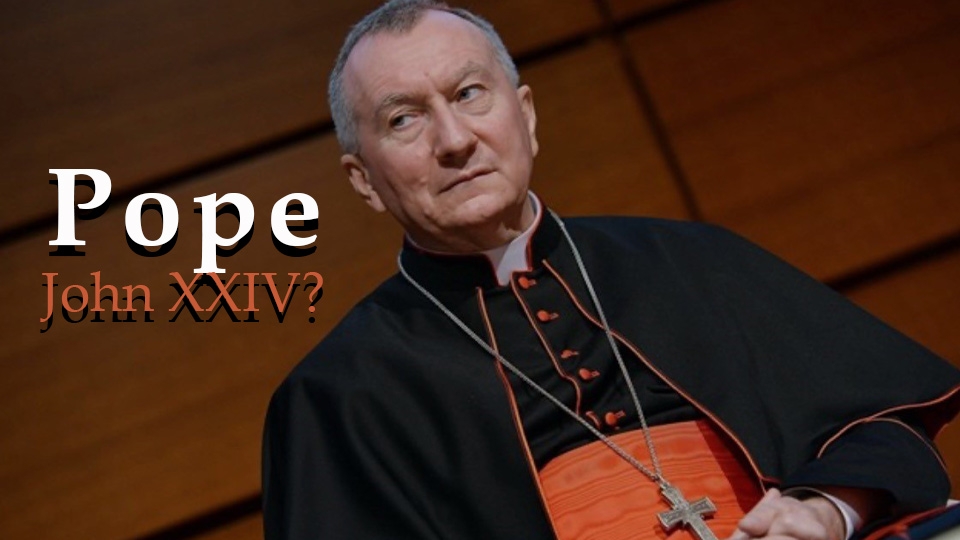

At exactly noon (Italian time) on April 29, 2025, the sixth General Congregation of the Cardinals came to an end. A few hours later, in an atmosphere suspended between reverence and secrecy, a rumor reached me—a tip-off, if we want to call it that. The kind that makes you jump out of your seat but, for intellectual honesty and professional rigor, must always be taken with caution. It said: “Parolin has already secured the majority. On the afternoon of May 8, white smoke. Pontifical name: John XXIV.”
At first, I must admit, I dismissed it as mere ecclesiastical political fiction. After all, in these days of anticipation and upheaval, the Sacred Palaces are a hive of speculation, ambitions, fears, and ecclesial projects. Yet, within hours, another voice—this time from a different source, equally well-connected within curial circles—reported the same thing to me. Coincidence? Pure suggestion? It’s not for me to say. The sources, to be clear, are reliable. But reliable is not synonymous with infallible.
What seems to be taking shape, at least according to these informal reconstructions circulating among those experiencing the Conclave from behind the scenes, is a subtle duel between two factions. On one side, there are the supporters of Pietro Parolin. On the other, the Community of Sant’Egidio, which has decisively backed Cardinal José Tolentino de Mendonça—a figure capable of attracting support from the more progressive sectors of the College of Cardinals, as well as a portion of the moderates and some influential American prelates.
Despite this, the modernists are said to have also devised plans in favor of the French Jean-Marc Aveline. He would be backed by the most ardent “synodalists,” including Cardinals Hollerich, Grech, and Marx. Aveline’s name could be kept in reserve if, during the Conclave, Tolentino is deemed too closely aligned with Bergoglio’s agenda—now unpopular with many. Aveline would already have his papal name ready: John XXIV (him too), as Bergoglio himself had suggested years ago upon returning from his trip to Mongolia in 2023. However, there remains a concrete obstacle—his limited proficiency in Italian, which could significantly impact the selection of the next Successor of Saint Peter. Meanwhile, Matteo Zuppi, disappointed because his candidacy has likely faded (as expected, after all), returned to Bologna for a day, officially “to recharge.”
Both factions claim to have a substantial number of votes, enough to approach or even reach the quorum (equal today to 89 votes). However, these assertions could merely be an electoral strategy—aimed at swaying other cardinals and steering them toward a candidate right from the earliest rounds, ensuring a swift resolution to the proceedings.
The conservatives, predictably in the minority, are said to have rallied around the Hungarian cardinal Péter Erdö, once endorsed by George Pell and seen as aligned with the Wojtyła-Ratzinger-Scola legacy. But here’s the real surprise, according to these unofficial leaks: a behind-the-scenes agreement, bordering on ecclesiastical realpolitik—an understanding between Parolin and the conservatives led by Erdö.
Parolin is said to have promised, in exchange for conservative support, a revision—or at least a “neutralization”—of Traditionis custodes and Fiducia supplicans. This scenario curiously mirrors, though in reverse, the dynamics of the 2005 Conclave, when Jesuit Carlo Maria Martini—the spiritual father of the Church’s left wing—chose to support Ratzinger in exchange for certain “favors,” as the time was not yet ripe for Bergoglio.
It seems that conservatives—one might suppose—hope to form a united front against Tolentino de Mendonça, who would certainly be a far worse choice for pope than Parolin, but also against Zuppi and Aveline.
French Cardinal Jean-Paul Vesco told the Italian press that the new Pope will not be Francis II, stating: “Peace is needed.” He further remarked, “I don’t believe this will be a long Conclave. It’s an intuition I had even before arriving in Rome.” Venezuelan Cardinal Porras Cardozo echoed the sentiment, saying, “There is convergence; I think the Conclave will last a couple of days.” Cardinal Louis Raphael Sako of Baghdad said, “It will be a short conclave, lasting two or three days. I have a very clear idea, but I cannot say it.” In short, official statements from the cardinals themselves seem to lend some credibility to the unofficial leaks—though they remain unverified.
However, caution is warranted. The cardinalial chessboard is never without countermoves, and the Conclave might prove to be far from brief, especially if the Parolin vs. Tolentino standoff reaches a frustrating deadlock.
Take, for instance, Cardinal Angelo Becciu, who, despite being excluded from the Conclave, is reportedly working to hinder Parolin—understandably, given his sense of betrayal. Meanwhile, the ultra-octogenarian cardinals—though without voting rights—are said to be exerting significant influence. Among them, familiar names: Giovanni Battista Re, Leonardo Sandri, and Beniamino Stella, a key supporter of Parolin.
On the other side stands the steadfast Camillo Ruini—likely the deus ex machina behind Erdö’s faction—who, in an interview with the renowned Italian newspaper Il Corriere della Sera, stated:
“We need a good Pope, one with governance skills, capable of navigating an extremely delicate and dangerous international phase. And we need a charitable Pope—charitable even in managing the Church.”
This statement, published precisely on April 29, seems, when read between the lines, to validate the corridor rumors of a pro-Parolin agreement. The phrase “good Pope” (Papa buono) inevitably evokes the figure of Pope Roncalli, whom Cardinal Parolin is known to admire. Parolin aspires to be a pragmatic Pope—revolutionary, yes, but with measured deceleration, tempering reformist impulses while avoiding any reversal. A Pope, indeed, “with governance skills, capable of navigating an extremely delicate and dangerous international phase.”
The Conclave is not an exact science. Rumors spread, strategies shift, names rise and fall like tides. Let us pray unceasingly that the cardinals may elect a Godly pope.
The widespread need for a Pope deeply familiar with global geopolitics appears undeniable—one able to maneuver through the complex realities of conflicts between Russia and Ukraine, Trump and Europe, China and Taiwan, Israel and Palestine, India and Pakistan.
In short, what is needed is a diplomatic pope—not a theologian like Ratzinger, but neither a politician like Bergoglio.
Yet, this is where a misunderstanding might arise. If Parolin is now considered the “acceptable conservative”, then the Church is indeed witnessing extraordinary times. One can only hope that Cardinal Joseph Zen—long a prophetic voice and a staunch opponent of Parolin due to the controversial secret agreements with Beijing—can still make his influence felt. If he manages to steer the conservative front toward a position of clear discontinuity—not just in contrast to Tolentino but also to Parolin himself—then there may still be a chance to rebalance the dynamics of the Conclave, moving beyond a choice that risks becoming a dead end.
Not everything is set in stone, indeed. A name is quietly circulating—without proclamations or media pushes: Pierbattista Pizzaballa. The Latin Patriarch of Jerusalem, a front-line shepherd, a mediator, yet firm in doctrine. Someone who might appeal to both reformists and conservatives. Younger by curial standards, Franciscan at heart, attentive to the poor and marginalized in a way that feels distinct from the ideological approach adopted by Bergoglio.
Amid these crucial days, between solemn silences and discreet maneuvering, one certainty remains: the Conclave is not an exact science. Rumors spread, strategies shift, names rise and fall like tides. Let us pray unceasingly that the cardinals may elect a pope according to God’s hearth. And let us wait, with watchful and vigilant minds, for the white smoke. Who lives, shall see.
Latest at RTV — The Pope & the Conclave: Can the Church Survive Francis II?