
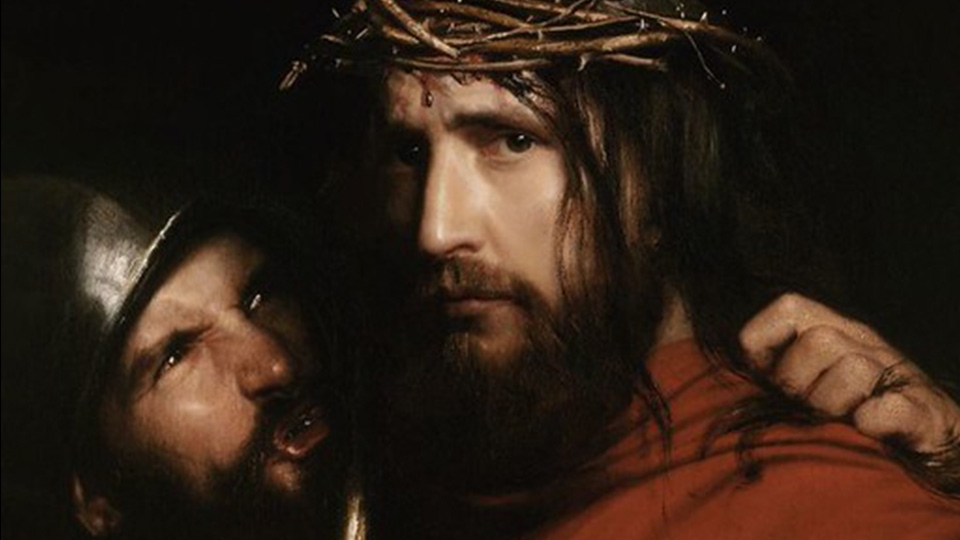

“Then the chief priests of the Jews said to Pilate: Write not, The King of the Jews…” (John 19:21) Amidst a deafening silence in the face of a rising death-toll that continues to climb into the tens of thousands, the slaughter of Christians in Syria, and the destruction of our ancient churches, the most urgent concern in the minds of many seems to be the suppression of the phrase “Christ is King”.
The holy season of Lent is once more upon us and, as we begin to move towards the dramatic events that compose Our Lord’s sacred passion and death, the successors of those who two thousand years ago on that first Good Friday declared that they had no king but Caesar are once again plotting against the kingship of their Messiah.
Amidst a deafening silence in the face of a rising death-toll that continues to climb into the tens of thousands (of which innocent women and children make up the vast majority), the slaughter of Christians in Syria and the destruction of our ancient churches, the most urgent concern in the minds of many seems to be the suppression of the phrase “Christ is King”, lest it offend any of those who happen to be represented by a nation-state that is at this very moment engaged in an unbridled war against an entire group of people. As the unspeakable slaughter of innocents continues unopposed, war, it seems, is now also being declared on the Prince of Peace.
The Network Contagion Research Institute (NCRI), a Jewish-run organization dedicated to identifying “hate groups” and combating “disinformation” (such as covid-vaccine scepticism), recently came up with a report un-ironically entitled “Thy Name in Vain: How Online Extremists Hijacked ‘Christ is King”, which suggests that “Christ is King” has become an anti-semitic slur.
This, however, didn’t just begin now. During last year’s Holy Week, events began to eerily resemble the sacred drama being played out in our churches’ liturgies as Christians witnessed a sudden hysterical slew of attacks against the declaration of Christ’s Kingship led by some of the prominent voices at the conservative media giant The Daily Wire. The suspiciously abrupt outrage was supposedly aimed at an “anti-Semitic” use of the phrase sent in a tweet by one of their former media personalities the year before. The incident under scrutiny had occurred months prior when, after having been smeared publicly by a colleague of hers for expressing concerns regarding Israel’s war on Gaza, the said culprit, Candace Owens — in an effort to avoid participating in a public feud — had sent out a tweet in which she quoted the scripture passage “blessed are the peacemakers”. The effort to tactfully address the scandal, however, was only met with further hostility by her colleague to which Owens responded by tweeting “Christ is King”.
The colleague, however, happened to be Ben Shapiro, an orthodox Jew, and the perpetrator of the supposed offense would eventually end up losing her position as a podcast host at the company. As mentioned, the concern regarding her use of the phrase did not get voiced until months after the initial tweet. It wasn’t until the start of Holy Week of 2024, following her termination, that the barrage of criticisms began.
Now, a year later, a similarly coordinated campaign has suddenly appeared again, seemingly overnight and with no apparent provocation, as we once more approach Our Lord’s Passion. The Network Contagion Research Institute (NCRI), a Jewish-run organization dedicated to identifying “hate groups” and combating “disinformation” (such as covid-vaccine scepticism), recently put together a research team, made up almost exclusively of Jews — among the few exceptions were one professing Christian and one agnostic, namely, Dr. Jordan Peterson (a man who’s made an entire career out of talking about Christ while consistently refusing to profess His divinity and kingship, even going so far as declining to acknowledge the existence of God) — and has come up with a report un-ironically entitled “Thy Name in Vain: How Online Extremists Hijacked ‘Christ is King”. This concern about the fear and reverence with which we should approach the Holy Name, unfortunately, doesn’t seem to extend to a media and Hollywood dominated by their own compatriots where the name of Jesus is ubiquitously used as a common curse word and where unabashed blasphemy freely reigns.
We are obliged to get ahead of the growing momentum and shout from the rooftops that we must not harm the Jew, but that we must, rather, love him. And because “perfect love casteth out all fear”, we must not self-censor, nor silence our sacred battlecry, but, instead, stridently proclaim, in the clear light of day, the Kingship of the Crucified One.
Conspicuously timed, just three days prior to the release of the NCRI report, The Catholic Information Center also hosted an event entitled “Catholics and Antisemitism—Facing the Past, Shaping the Future”. The event was organized by the zionist front organization, The Philos Project founded by the vulture capitalist Paul Elliott Singer , who, of course, also happens to be Jewish. The conference consisted of praise for the state of Israel, calls to inter-religious worship and condemnations of anti-Semitism — which was said to be motivated by envy of Jewish success and influence (something that, apparently, can actually be admitted if you’re careful enough to present it in an exclusively positive light). Adding to the chorus of concerns were, once again, personalities at The Daily Wire — the original instigators of the “Christ is King” controversy — who sent out a number of long theatrical and accusatory tweets on the matter.
Rather troubling in all of this — especially regarding the Catholic-led Philos Project event — is the fact that the term “anti-Semitism” is never given a precise definition (An odd term to begin with, as most Semites happen to be Arabs). The growing anxiety over the proposed anti-Semitism threat seems to conflate any criticism of the state of Israel, Judaism or Jews in general, with hatred and a desire to enact violence or harm on Jews. This is especially problematic for Catholics, since we have a long theological tradition describing an enmity between the Church and the Synagogue — one which, I might add, it’s not apparent that one ambiguous Church document and a few papal remarks have the magisterial force to overturn.
There is, in fact, so much obfuscation surrounding the topic that not only is there no clear understanding or consensus with regard to the term “anti-Semitism” but even the very category of “Jew” has become utterly mystifying for many. Is a Jew an adherent of the Old Covenant, or simply someone with Jewish ancestry? Are secular Jews, Jews? What of converts from Judaism? Or converts to Judaism? Most importantly, what of Our Lord, Our Lady, the Apostles and most of the first-century Christians? What is a Jew (perhaps a good title for a new documentary)?
If we look at the New Testament we can already begin to see the category of “Jew” applied distinctly to that particular group of Jews that rejected the Messiah. Although the term is not entirely univocal in its use throughout the Gospels and Epistles, what is clear is that the coming of Christ created a schism within first-century Judaism that eventually led to one group being called Christians, namely, those who accepted Jesus of Nazareth as the promised Messiah, and another group being called Jews — made up of those who rejected Him. This schism reached its culmination in AD 70 with the destruction of the Jewish temple and, along with it, the end of the Old Covenant religion. As a result, Rabbinic Judaism developed as a means of maintaining Jewish identity in the absence of a temple and a sacrifice. The new religion would now be centered around the Talmud together with an Anti-Christian reading of the Old Testament that relied on the same Talmud for its interpretation.
A very real danger lies in a coopting of the Adversus Judaeos tradition by secular voices — as we saw happen in the last century — and if we continue to ignore the rising tide of grievances concerning such blatant offenses as the ongoing genocide of the Palestinian people, or the Israeli stranglehold on our government and its foreign policy.
So, what then is a Jew? There’s no doubt that there are today many non-practicing, non-believing secular individuals of Jewish stock who would still consider themselves Jewish — and, I would add, others within the community would readily acknowledge them as such. At the same time, we can find others who share no Jewish ancestry yet, nevertheless, convert to Judaism and are, again, considered by all to now also be Jewish. What then, one might ask, is the common denominator between these two groups? It shouldn’t be regarded as controversial to simply recognize that what unites them is that each one identifies and claims solidarity with that initial group, namely, that corporate body who on Good Friday explicitly rejected Christ and called for His crucifixion. For if they identified with the other group in the story, they would simply be called Christian. The Jew may claim that he believes and embraces the Old Testament, but so do we as Christians. He may insist that he worships the God of Abraham, as we know we truly do. He may even claim direct genealogical descendance from the original Hebrew nation, as did most of the members of the nascent Church (To further emphasize the lack of significance genealogy has in relation to Jewish identity, recent genetic studies have revealed that most Palestinians are, in fact, the descendants of Jews. Something that even the early Zionist leadership was aware of and readily acknowledged). What sets the Jew apart and gives him his particular identifying character are not any of these claims but, rather, his explicit rejection of, and opposition to, Jesus as the Christ. This, and nothing less, is what sits at the core of Jewish identity. Everything else surrounding it centers around this one truth, namely, the rejection of truth itself. That is, the rejection of the Incarnate Logos.
The question that must now be asked is whether acknowledging this and adhering to the Church’s two thousand year old tradition on the matter now makes one an anti-Semite, which, whatever the actual meaning of the nebulous term may be, clearly has increasing social and legal ramifications for individuals labeled as such. Equally concerning is the lack of willingness on the part of fellow Catholics, let alone the clerical hierarchy, to engage in an open and honest discussion on matters surrounding the topic. Those who take this approach will likely find, much to their dismay, that such refusal will, in the end, only more quickly bring about the very evils their silence is hoping to forestall. A very real danger lies in a coopting of the Adversus Judaeos tradition by secular voices — as we saw happen in the last century — and if we continue to ignore the rising tide of grievances concerning such blatant offenses as the ongoing genocide of the Palestinian people, or the Israeli stranglehold on our government and its foreign policy, we will soon, no doubt, witness another ideological reaction leading, once more, to unmitigated disaster.
Consequently, we are obliged, if nothing more, to get ahead of the growing momentum and shout from the rooftops that we must not harm the Jew, but that we must, rather, love him — if for no other reason than that we must love our enemy. And for this very reason, because “perfect love casteth out all fear”, we must not self-censor, nor silence our sacred battlecry, nor in any way conceal our allegiance behind shut doors “for fear of the Jews”, but, instead, stridently proclaim, in the clear light of day, the Kingship of the Crucified One.
¡Viva Cristo Rey!
Josué Luis Hernández is a freelance writer whose essays have appeared in The European Conservative, OnePeterFive and La Esperanza. He is the founder of The Pascua Project, which seeks the integration of New Urbanism, Agrarianism, Distributism, the Liberal Arts, Historical Rootedness and the Liturgical Year in order to rebuild an authentic traditional Catholic life and culture. He lives in Miami with his wife and children.
