
Since the advent of Traditionis Custodes our Bishop has retained two locations in our diocese where parishioners can have access to the Tridentine Rite with committed priests who offer both liturgical forms each Sunday. This gracious gesture reflects the pastoral sense of a Good Shepherd who knows the smell of his sheep and continues to meet their spiritual needs, even in the face of an abusive governance from the Church out of Rome. I fully realize it is a challenging time to be Catholic, but I also recognize the gift of being one currently as well.
Part 1: Discovering The Mass of the Ages
For the first thirty years of my life, I was a functioning pagan in-spite of receiving all of my sacraments in the Novus Ordo Church. I had fallen into a very immoral life but began to crawl out of it with the help of a Catholic men’s group led by a now deceased priest. The priest was the chaplain at a Catholic high school where I was currently teaching. After an initial reversion in this environment, my faith was tested in September 2008 by facing my greatest fear, being the parent of a seriously disabled child. That fear manifested itself in a devastating prenatal diagnosis sixteen weeks into my wife’s second pregnancy. We were told our child was diagnosed with a birth defect so severe that 80% of the couples who receive this diagnosis choose abortion. We chose to pray for a miracle. That journey is chronicled in my first book, Waiting for Eli: A Father’s Journey from Fear to Faith. That child is now approaching his 15th birthday.
Following his birth, I began speaking all over the country sharing that journey. I eventually found myself appearing on EWTN with Raymond Arroyo, as a keynote speaker at the March for Life in Washington DC in 2014 and functioning as a full-blown Catholic apologist while still teaching full-time. Nudged by students and cooperating with Divine providence I shifted from the history department in one Catholic school to a Theology department in another one.
At this point the world was three years into the Francis Pontificate and most faithful Catholics had yet to realize how scandalizing his method of governance over the next seven years would be; I was one of them. Over that period, numerous events have revealed the damage and division brought about because of ill advised statements and constant ambiguity on doctrine.
Before these things became clearer, I was completely unprepared for what this Pontificate would project as Catholicism to the world. As a newly hired theology teacher, I was too focused on learning about philosophy, apologetics, and Church history offered by Dr. Taylor Marshall through his online school, the New St. Thomas Institute. As a career long teacher, I humbled myself and became a student again. I learned a great deal from his earlier works as a purely Thomistic philosopher/theologian who was still teaching through the lens of Benedict XVI’s hermeneutic of continuity. This was prior to him becoming the well-known you-tube Catholic commentator he is today.
In May of 2018, I was appointed as the Director of Catechesis for my diocese just as I was finishing my seventeenth year in Catholic education and publishing my third book in a series about my son, Growing with Eli: Our Journey into Life and Light. It was that journey with Christ in authentic redemptive suffering that brought me to a place where I was offered for this unique opportunity to serve.
I found that treasure in the Tridentine Rite of the Holy Sacrifice of the Mass. I was willing to sell everything I had known before to possess “that field” and share it with my family. I was aware that trying to facilitate this shift of mentality and practice within my personal and professional life would create a daily conflict of conscience because I worked within the halls of a Chancery during the reign of a Pope who had made it very clear in repeated public statements his personal disdain of the Latin Mass and the entire Pre-Vatican II culture it thrived in.
Enter July 2018, just one month after the “Summer of Shame” sparked by the revelations of Theodore McCarrick, I began my work in the diocese. Being much more in tune with my Catholic faith and having salvation for myself and my family as the priority of my life, I was in both shock and disgust with the revelations that had taken place in the hierarchy of the Church. I desired to sincerely improve the horrific catechesis that had been provided over the past six decades while being a faithful servant to a Successor to the Apostles.
As I learned how to navigate Chancery life and run a dicastery as a committed orthodox Catholic, I began to see things from the inside that drastically changed my preconceived notions prior to my employment. I was listening intently to you-tube episodes about all the controversial things that had come out of Rome and the Magisterium that were directly affecting my ability to provide clarity and sound catechetical formation in the diocese. With apparent heterodox teaching that was being debated on the same footing with timeless orthodoxy following the debacle of the Synod of the Family in 2014-15 which gave birth to Amoris Laetitia. On the heels of this controversy, came the proposed change to the teaching on the death penalty within the1992 Catechism and the controversial lines in the Abu Dhabi document suggesting God actively wills a diversity of religions. The Pope verbally contradicted his own CDF document from 2021 on civil unions in a Netflix series that has now become actualized in Fudicia Supplicans. The Pachamama incident from the Amazonian Synod followed by the global Covid restrictions and the denial of access to the Holy Sacrifice of the Mass for most of 2020, created unnecessary challenges to bringing sound catechesis to my diocese. The refusal of the Vatican to support those who had moral reservations to the Covid Vaccine because of its connection to an aborted fetus, which contradicted their own CDF document and its direct impact on my wife as a nurse in a Catholic hospital brought me to new level of indignation.
Just as in 2018, I found myself in shock and scandalized again. The lack of response and outright silence of much of what I had perceived to be orthodox members of the Magisterium was deafening. The coexistence of Pope Francis and Pope Emeritus Benedict XVI didn’t help the situation. Nor did Benedict’s looming presence bring any comfort despite knowing he had fully repudiated the “Spirit of Vatican II” thoroughly as the former CDF and reigning Vicar of Christ from 2005 – 2013. The current Pontificate of Francis was communicating through words and actions an endorsement of the “Spirit of Vatican II” the very thing that Pope Benedict had denounced. These actions by Pope Franis were not a continuation of the hermeneutic of continuity, but rather appeared to be a hermeneutic of rupture with the preceding Popes. I was looking for answers and wasn’t finding any from previous places of comfort and confidence following my 2008 reversion. I had no idea I was about to discover and feel what most biblical based Protestants do the first time they read a Church Father or comprehend Church History; a shifting foundation.
In 2019, after being a seven-year student at the New St. Thomas Institute and ardent reader of Dr. Taylor Marshall’s articles and books I was part of the launch team for his now bestselling book, Infiltration: The Plot to Destroy the Catholic Church from Within. I read with great interest and a keen awareness of how blind I had been to some major 20th century events surrounding the onset and arrival of the Second Vatican Council. The effects of these events were directly unfolding in real time within the contemporary universal church. Seeking guidance on these issues, God’s providence brought me in contact with a young diocesan priest who celebrated both the Novus Ordo and Tridentine Mass in his parish. I am an avid reader and began to devour every book I could find written by Traditional Catholics from just about every corner of that world on these events and liturgical reform. I wanted to understand this from their perspective. Not just the narrative about that perspective that I had heard and accepted for so many years.
My reading and inquiry prompted me to begin attending weekly low Masses offered at a remote parish in my diocese. While learning the flow of the Liturgy and actively participating in silence with my personal Missal from the pew, I discovered a hidden treasure and received a spiritual nourishment I had never experienced before. Within this newly discovered treasure, I experienced a connection to the Communion of Saints in Church Triumphant whose lives of holiness I had studied and desired to imitate. This treasure enriched my own interior life so much that I desired for other Catholics to have the opportunity to experience the same thing.
From my experience, I have empathy for faithful Catholics who have a zeal for souls and struggle with transparency over what is unfolding in their conscience because of the constant polarization in the Church over this issue.
Motivated to continue my deep dive my study gave me the ability to clearly see the points Traditionalist had been arguing for since the dramatic liturgical “reform” following the Second Vatican Council. Additionally, I could share a cohesive understanding of their legitimate theological questions concerning an apparent contradiction between pre and post – conciliar doctrines of the Catholic Faith, such as religious-liberty, ecumenism, and religious indifferentism. Following my reversion, I had grappled with these same issues in my conscience within phrasing in the modern catechism. However, I didn’t have both sides to view and accepting the post – conciliar presentation of them through the lens of continuity with the past, I didn’t see what I do now. Seeing the whole historical picture, one could only continue to hold that line of reasoning through a set of mental gymnastics not necessary in a divinely revealed faith known for its clarity.
I desperately wanted to share with my wife and children the treasure I found. I wasn’t sure how to bridge the gap for them after almost forty-two years of life in the only form of Catholicism we had ever known, that of the post-conciliar Church. Then entered the next stage of God’s Divine Providence on this unexpected journey…
Part 2: Discovering the Mass of the Ages
“The kingdom of heaven is like a treasure buried in a field, which a person finds and hides again, and out of joy goes and sells all that he has and buys that field.” (Mt 13:44-45)
I found that treasure in the Tridentine Rite of the Holy Sacrifice of the Mass, and it had buried itself deep within the field of my heart. I was willing to sell everything I had known before to possess that field and share it with my family. I was aware that trying to facilitate this shift of mentality and practice within my personal and professional life would create a daily conflict of conscience because I worked within the halls of a Chancery during the reign of a Pope who had made it very clear in repeated public statements his personal disdain of the Latin Mass and the entire Pre-Vatican II culture it thrived in. This was confirmed in July of 2021, when Pope Francis took canonical action that gave legal sanction to eradicate its availability to numerous lay faithful who desired it. My personal conviction and the promptings of the Holy Spirit beckoned me to trust in God’s Providence and will in my life as his disciple regardless of the cost.
In July of 2021, my leap of faith was confirmed after I received an invitation to be one of the pre-screeners of the first episode of the three-part documentary series, Mass of the Ages. My family watched episode one with great enthusiasm and empathy. Over the past fourteen years of our second child’s life, we have witnessed him endure five major life-threatening brain and spinal surgeries. The most dramatic one occurred on Easter weekend of 2011 when numerous prayers of petition were heard by Blessed Francis Xavier Seelos. Seelos is a beautified Redemptorist Priest who lived in New Orleans, Louisiana, during a yellow fever epidemic in the 19th century and died while ministering to his parishioners. His intercessory prayer saved my son’s life and produced a bona – fide miracle that a pediatric neurologist with over forty years of medical experience couldn’t explain. This past traumatic event with our child was brought into the present moment in our hearts and minds in the life story of the widow in the Mass of the Ages, Episode 1. She had lost her husband and in that tragic suffering, found comfort and support in the TLM community. As the credits rolled down the screen, we all were in awe and wonder of what we had just seen. Peering into the window of the souls of both my visibly moved wife and enamored children I had to ask, “If I could take all of you to a Mass like that on the weekend would you be willing to go?” All of them responded simultaneously with a resounding “yes.” The joy I had found in this treasure expounded exponentially and was again confirmed in their answer.
The following weekend my family experienced their first Solemn High Mass at a diocesan parish I regularly serve in my position at the Chancery. It was bejeweled with sound catechetical preaching, an army of altar boys, a men’s schola singing inspiring Latin chants of the Gloria, the Credo, the Sanctus, the Agnus Dei. And as a jeweled crown of twelve stars, the Salve Regina during the closing procession. Sitting in the silence afterward I became aware of something I had not realized before, but I am keenly now aware. These gems were the very things I had longed to experience in every Mass I have the privilege to attend, not just during certain times in the Liturgical season, like Advent, Christmas, Lent, and Easter. I have witnessed for far too long in my own diocesan settings how they are given token use for a short time during these seasons and then disregarded afterward.
I have virtuous friendships with individuals in both Traditional and Novus Ordo circles in my diocese that are centered on the salvation of souls. Their similarities far outweigh their differences. I am certain those similarities would better serve Christ’s kingdom if they were to unite rather than allow themselves to be continually divided.
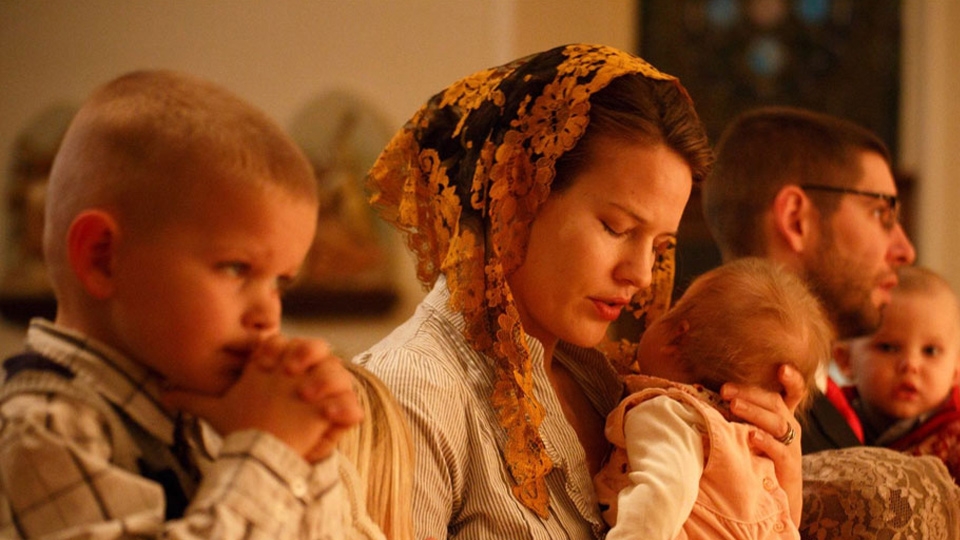
The pews in the Nave of the Church were packed with intergenerational individuals and families of varying sizes. Every parishioner entered in silence and remained so while being present at the mystery of Calvary, the representation of Christ death and Resurrection in the reality of transubstantiation happening before their very eyes was truly breathtaking. I was astounded how much easier it was to pray during and following the reception of the Eucharist with the soothing Gregorian Chant permeating the walls of the Church from the choir loft and the deep synchronized voices of the all-male schola above. The communion rail at the edge of the sanctuary beckoned each eager communicant to approach in humility by receiving the Eucharist kneeling and on the tongue. The entire scene echoed a reverent awareness, piety, humility, and sense of urgency regarding the gift that was being offered from the tree of life; Christ Himself.
I marveled at the number of young people in this congregation. They were the demographic that have perpetually abandoned the practice of their Catholic faith within Novus Ordo parishes I had been tasked to serve daily. It was obvious they needed no gimmick or incentive to be there, they had chosen to be at this Mass all on their own. Their piety and intensity reverberated. The sustained silence before, during, and following Mass offered an atmosphere that is sorely absent in most modern parishes I frequently attended. I had been taught theologically that the Mass was a taste of heaven on earth, but I have never seen it incarnated in that way before. As my family and I were walking out of the church I turned to my wife and said, “What do you think?” She replied, “I never want to go anywhere else for Mass except here from now on!” That was four years ago, and we haven’t looked back.
Constitution of the Sacred Liturgy from the Second Vatican Council. According to this document Gregorian Chant and Latin were given “pride of place in liturgical worship.” Why was that never the case at the Novus Ordo Masses I had attended almost my entire life? This epiphany revealed a buried and subconscious inconvenient truth which my soul had longed for at every Mass. Now that it had been fed in such a way, there was no way to return to what I had thought I knew. I believe most contemporary Catholics view Sacrosanctum Concilium through the lens of the present peering back into the past rather than through the lens of the past now peering into present.
The Novus Ordo liturgy did not exist when it was written, and the “reforms” that came because of it did not produce what the document appears to have originally intended. I also discovered that many of the parts of the Tridentine Rite are Apostolic in origin. It was developed into what I witnessed through the 1962 Missal over the centuries by the inspiration of the Holy Spirit working in the Apostles successors such as St Gregory the Great and St. Pius V. Catholics have perfected the liturgy over the centuries more elegantly than anyone else because their origin is not human but divine. This gradual movement of the Holy Spirit within the Church was not, as Modern liturgists suggest, a series of medieval concoctions of scholastic theologians. The Latin Rite, commonly called the Tridentine Mass, is the 1500+ year old Mass of the Ages.
In January 2023, I had an opportunity to share parts of this story on Dr. Taylor Marshall’s You-tube channel. Three of my children have received all their Sacraments of Initiation. In 2022, my oldest son was Confirmed in the New Rite via the Novus Ordo, while his two younger brothers simultaneously were Confirmed in the Old Rite within a local TLM community. I have virtuous friendships with individuals in both Traditional and Novus Ordo circles in my diocese that are centered on the salvation of souls. Their similarities far outweigh their differences. I am certain those similarities would better serve Christ’s kingdom if they were to unite rather than allow themselves to be continually divided.
Since the advent of Traditionis Custodes our Bishop has retained two locations in our diocese where parishioners can have access to the Tridentine Rite with committed priests who offer both liturgical forms each Sunday. This gracious gesture reflects the pastoral sense of a Good Shepherd who knows the smell of his sheep and continues to meet their spiritual needs, even in the face of an abusive governance from the Church out of Rome. I fully realize it is a challenging time to be Catholic, but I also recognize the gift of being one currently as well.
From my experience, I have empathy for faithful Catholics who have a zeal for souls and struggle with transparency over what is unfolding in their conscience because of the constant polarization in the Church over this issue. What remains before us is the call to bring from the lofty heights of theory into the concreteness of reality the possibility of living Tradition amid a Novus Ordo world.
