

By now, the world is familiar with the controversy over the 2024 Paris Olympics Opening Ceremony performance which bore similarities to Leonardo da Vinci’s Last Supper. As much as Catholic objections to the perceived mockery of Christ’s sacred last meal before his Passion are valid, the performance demands confrontation with an even harsher reality than simply that of a staged show.
Leonardo’s Last Supper as Background
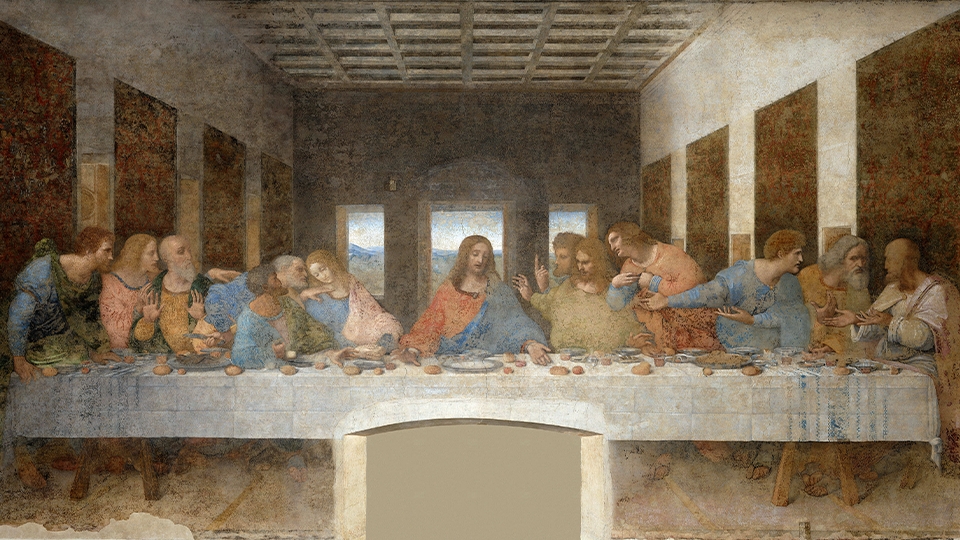
Leonardo’s Last Supper mural is the most famous image of Christ, painted for the refectory of the Santa Maria delle Grazie Dominican monastery in Milan. It shows Jesus and his twelve disciples, seated mainly along a single long side of a table. The artist likely disposed them thus to make clearer each character’s individuality. A real-life meal might have more naturally arrayed its participants around the entirety of the table. Hence, Leonardo was conscious of creating a spectacle. The Olympic “Last Supper” performance was also by its very nature intended as spectacle.
In Leonardo’s painting, Christ is the central focus. Perspectival lines converge at his left temple. He sits at the middle of the group and is spatially slightly apart from the rest, recalling his holiness, or being set apart for a sacred purpose. His image forms an equilateral triangle, a reminder of his membership of the Trinity. The triangle’s base rests along the centre of the table’s length, being sandwiched roughly between the lowest and middle horizontal thirds of the composition. His is the most stable figure, contrasted against the general dynamism of the disciples, whose poses suggest psychological perturbance or at least visual asymmetry.
The Opening Ceremony’s artistic director Thomas Jolly has denied using Leonardo’s fifteenth-century Last Supper as the basis for the said performance. Paris 2024 producers apparently flatly contradicted him by saying it was indeed.
The anchoring capacity of Leonardo’s Christ conveys deeper spiritual meaning. The depicted supper was not just Jesus’ last meal before the Passion. It was also a key first at which he instituted the Eucharist, the “source and summit of the Christian life” (CCC 1324). The Eucharist is a sacrament — a sacred sign administered through a rite — which visibly manifests the invisible glory and workings of God in providing inward grace (the ability to partake of divine life) to its recipient. Otherwise called Holy Communion, the Eucharist is the central rite of the Catholic Church whence all other graces and goodness flow.
Till today, visual representations of the biblical Last Supper story are simultaneously sobering and joyous reminders of the price at which divine life was purchased for humanity. This price was Christ’s very body, blood, soul and divinity, offered through his death on the cross.
John’s gospel relates an episode before the Last Supper where Jesus says to a much larger crowd, “I am the bread of life … if any one eats of this bread, he will live for ever … the bread which I shall give for the life of the world is my flesh … for my flesh is food indeed, and my blood is drink indeed” (Jn 6:48; 51; 55). Later at the supper, Jesus breaks bread, saying, “Take; this is my body” (Mk 14:22), and passes around the wine, saying, “This is my blood of the covenant, which is poured out for many” (Mk 14:24). The understanding of the Church is that Jesus literally turns bread and wine into his own flesh and blood to become food for the gathered twelve. This transformation of bread and wine into the substance of Christ’s body and blood, while keeping the appearance of bread and wine, is repeated at every Catholic mass, through the priestly consecration of those elements. The consumption of the body and blood, through Holy Communion, is for a baptised and repentant Catholic the furthering of their ability to lead the life necessary for eternal salvation.
This means the sacrifice on the cross really begins at the Last Supper the previous day, without which there is no making sense of the crucifixion. This typically Roman method of execution could be nothing more than a Roman execution, nor understood as a Jewish priestly sacrifice, without Christ’s words and actions at the Last Supper to offer up his entire being through his death the next day. It is at this, Christ’s institution of the Eucharist at supper, from where springs the pivotal act of salvation for humanity.
Leonardo to France: Do You Copy?
The Opening Ceremony’s artistic director Thomas Jolly has denied using Leonardo’s fifteenth-century Last Supper as the basis for the said performance. Paris 2024 producers apparently flatly contradicted him by saying it was indeed. Others have suggested the seventeenth-century painting The Feast of the Gods by Jan van Bijlert as a more likely source.
Whether one believes Jolly or the producers may be irrelevant. In the visual and performing arts (assuming this performance is artistic), perceived adaptation from an earlier artwork — whether conscious or unintentional by the artist, either with or without their acknowledgement of the inspiration — is deemed as testimony to the influence of the earlier work. This is so even if the later work appears to contradict the spirit of the earlier. Art history is nothing if not about how individual artworks significantly affect the way later generations make or understand images.
Snagging the High Renaissance genius to serve in-house would contribute to France’s being the greatest European power of the day. Irreverence for Catholicism begotten of the French Revolution, however, now presses a new variation on his Last Supper into the service of an officially woke France.
It is worth arguing, therefore, that the Olympic performance was truly a take on Leonardo’s Last Supper, but one respecting not its spirit. Even the Bijlert, with its thirteen pagan deities at a long table, the central of whom is haloed and plucking a lyre (Apollo, god of light and analogue of Christ in classical mythology), suggests Leonardo’s influence. Whatever the exact relationship between the Paris performance and Leonardo, cross references are unavoidable.
The Paris performance showcased French values considered politically appropriate. The occasion for this spectacle is the big-ticket event signaling international approval of a host nation; nobody would propose holding the Olympics in North Korea. In the words of Paris 2024 spokesperson Anne Descamps, “Thomas Jolie really tried to … celebrate community tolerance”. Evidently this entailed a Last Supper-like live diorama of drag queens, male genitalia peeking out from beneath hot pants, a practically naked Bacchus-figure, and amid them, a child.
Centrally anchoring this buffet of earthly delights was a fat woman with bared cleavage. Her headdress resembling a radiant and elevated Holy Communion host calls to mind the Blessed Sacrament displayed for adoration in a monstrance.
This perceptible association between woman and monstrance contains further interpretive possibility. Not only might the fat woman parody Leonardo’s Christ, but also that other woman most sacred in Catholicism — his mother the Blessed Virgin Mary. As a monstrance contains the bread of life, so does the pregnant Virgin. The words of angel Gabriel when announcing Mary will be with child, “the Lord is with you” (Lk. 1:28, emphasis mine) are taken by the Church as truth eternal, repeated still in the Hail Mary prayer. Conversely, Mary is with God. Whether as the Father’s beloved daughter, mother of the Son, or spouse of the Holy Spirit, her special association with the Trinity means slurs cast upon them land on her too.
References to Leonardo’s Last Supper are encouraged by his having been brought to France in 1516 by Francis I, its great Renaissance king. Snagging the High Renaissance genius to serve in-house would contribute to France’s being the greatest European power of the day. Irreverence for Catholicism begotten of the French Revolution, however, now presses a new variation on his Last Supper into the service of an officially woke France.
Outrageous as was the Paris performance, it did not drop from nowhere. The “garden-variety” irreverence at eucharistic celebrations across swathes of today’s developed world acted as progenitor and critical mass to fuel the world-class shock-show.
Where to, from Paris?
Outrageous as was the Paris performance, it did not drop from nowhere. The “garden-variety” irreverence at eucharistic celebrations across swathes of today’s developed world acted as progenitor and critical mass to fuel the world-class shock-show.
Poor dress at Catholic mass reflects the attitude that worship, and therefore Christ, are not worth reverent attire. Males often wear Bermuda shorts; women have increasingly exposed shoulders, plunging necklines, bare midriffs and ever tinier shorts allowing even for partly uncovered posteriors. Low importance placed on frequent repentance through confession before communion; habitual lateness and early departure; frequent texting, chatting and snacking are commonplace. Poorly prepared and weak homilies with moral silence, ambiguous or even plainly secular messaging, and whimsical and personalised alterations to the liturgy too play their part.
Resistance from individuals implicated in such behaviour, when politely asked to improve, is common. All these and more, alongside high rates of disbelief in the real presence of Christ in the Eucharist across the developed world (roughly inferred from the 69 per cent among professed American Catholics, as discovered by the 2019 Pew survey), point to the declining centrality accorded to Christ and his sacrifice at regular celebrations of the source and summit of the faith.
In art, major developments in how images look gestate over long periods, in which the surrounding environment acts like marinade on meat. The aesthetics of irreverence at Catholic mass and the institutional lapses behind them have plenty to do with what happened in Paris. As much as Catholics rightly deplore its travesty, it is high time for all laity and clergy to ask if our own permissiveness or participation in irreverence is nudging non-believers to use scenes from Catholic life as fair game for sexualised mockery.
Rachel Lucy Choo writes on Christian art and architecture, and has a master’s degree in art history from the University of London.
